
User experience and digital design
User experience and digital design
We design digital systems and platforms around user experience, efficiency and usability—from research and information architecture to interactive prototypes, UX/UI design and usability testing.
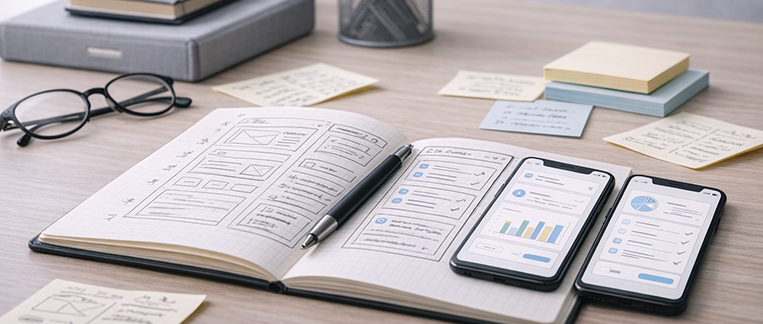
Intuitive systems that help users work faster
A good user experience reduces the learning curve, error rates and demand for support, enabling employees and customers to complete tasks more clearly and quickly. We base our solutions on real user needs, test prototypes and move to final design only once the direction has been validated.
Common challenges:
systems are complex and difficult to understand
users make mistakes or avoid using the system
tasks take longer than they should
Our approach: users first, functionality second. We design systems around how people actually use them.
What the service includes
User research and personas
We analyse user groups, needs, working environments, motivations and the main scenarios in which the system is used.
User journey analysis
We map the current and target user experience, identifying key touchpoints and opportunities for improvement.
Information architecture design
We create a clear structure for content, functionality, navigation and screens, tailored to different user roles.
UX/UI design and usability testing
We develop interactive prototypes and visual designs, then test them with target users.
Value to client
Lower delivery risk
Ergonomically designed workspaces reduce unnecessary steps and errors.
Better customer experience
Convenient self-service and digital services increase satisfaction and trust in the organisation.
Higher productivity
Prototype testing validates design decisions before investment in development.
Easy-to-use systems
Clear structures and consistent interactions help users quickly understand how to complete tasks.
Service model
The services can be delivered either as a standalone initiative or as an integrated part of the full project lifecycle:

User research
Duration: 2–4 weeks
Includes
•
Interviews and observation
•
Analysis of user groups, needs, problems and scenarios
•
Interviews and observation; analysis of user groups, needs, problems and scenarios
Result
User insights
Personas
Priority areas for improving the user experience

Information architecture and prototyping
Duration: 3–6 weeks
Includes
•
Content and functionality structure
•
User flows
•
Screen layouts and an interactive prototype
Result
A testable prototype of the future solution
A testable prototype of the future solution
A testable prototype of the future solution

UX/UI design
Duration: 4–10 weeks
Includes
•
A design system
•
Designs, states and developer specifications for all key screens
•
A design system; designs, states and developer specifications for all key screens
Result
Consistent, accessible design ready for implementation
Consistent, accessible design ready for implementation
Consistent, accessible design ready for implementation

Usability testing
Duration: 2–4 weeks
Includes
•
Test scenarios
•
Sessions with target users
•
Analysis of results and recommendations
Result
Evidence-based findings
Specific design improvements
Evidence-based findings; specific design improvements
When this service creates the most value
when it is necessary to reduce errors, support requests or unnecessary steps
when an existing system is difficult or unclear for users, or requires extensive training
when creating a new information system, self-service portal or digital service
Create a digital experience that is easy to understand and use
Let’s start with user needs, a prototype and design decisions validated through real-world testing.
Discuss the project